

When Tess assumed responsibility for supporting and modernizing Frankentek security systems, we were presented with a challenge that many vessels face as they evolve: how to integrate reliable legacy infrastructure with modern, open-standard automation systems.
Frankentek, founded by Marc Franken, developed robust and efficient yacht security systems built around a proprietary communication protocol known as T-Bus. This architecture allowed dozens of security door contacts to be connected through a simple daisy-chain network, significantly reducing wiring complexity and improving installation efficiency.
From an engineering standpoint, it was an elegant and reliable solution.
However, as vessels modernize their alarm and monitoring platforms, proprietary protocols such as T-Bus create a barrier to integration. Modern bridge systems, alarm platforms, and remote monitoring solutions rely on open, industry-standard protocols such as Modbus.
Without a translation layer, operators face a difficult choice: replace the entire security infrastructure or accept isolation from modern monitoring systems.
Replacing the system would require running individual cables to every door contact throughout the vessel — an invasive, costly, and time-consuming process, particularly in finished interiors.
Instead of replacing a proven and reliable infrastructure, we chose to modernize it.
Engineering a protocol bridge — preserving infrastructure, enabling integration
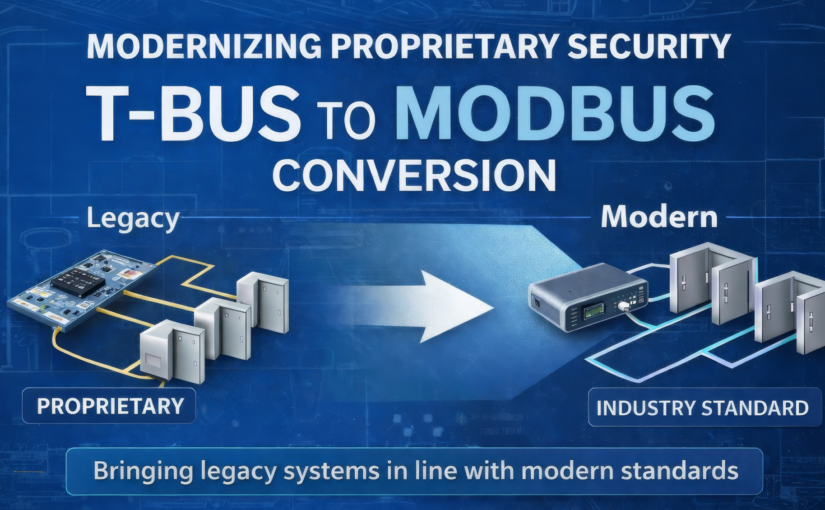
The Tess engineering team designed and implemented a T-Bus to Modbus conversion solution that allows existing Frankentek security door contacts to communicate seamlessly with modern automation and monitoring systems.
This approach allowed us to:
- Preserve the existing daisy-chain T-Bus wiring infrastructure
- Eliminate the need to run new cables throughout the vessel
- Translate proprietary door status data into Modbus, an industry-standard protocol
- Enable integration with modern alarm and monitoring platforms
- Reduce installation time, cost, and vessel downtime
By converting T-Bus data into Modbus registers, legacy security systems can now communicate directly with modern bridge and monitoring systems without replacing the original hardware or wiring.
This creates a sustainable modernization path while protecting the vessel owner’s original investment.
Overcoming the challenges of proprietary protocols
Integrating proprietary communication systems requires a deep understanding of both legacy and modern protocol behavior.
Unlike standard industrial protocols, proprietary systems often rely on specific polling sequences, binary message structures, and precise communication timing. Achieving reliable integration required careful analysis, protocol interpretation, and extensive validation to ensure consistent and deterministic performance.
Through engineering and testing, we successfully created a stable and reliable bridge between the original Frankentek T-Bus system and modern Modbus-based monitoring platforms.
Collaboration and continuity
This effort reflects the continuation and evolution of the original Frankentek system design.
Frankentek, founded by Marc Franken (www.yachtsecurity.com), established a robust and efficient security architecture that continues to serve vessels reliably today.
At Tess (www.tesselec.com), our engineering team — including Bert Oostenbrink, Oleksii Kozachenko , Leendert Wolf — has focused on ensuring these systems remain serviceable, maintainable, and compatible with modern vessel automation standards.
This work represents not replacement, but continuation: preserving proven infrastructure while enabling integration with modern technology.
Enabling the future while preserving the past
Modernization does not always require replacement.
By bridging proprietary legacy systems to open industry standards, vessels can benefit from modern monitoring, integration, and scalability while preserving the reliability and efficiency of existing infrastructure.
At Tess, our goal is to provide sustainable, engineering-driven solutions that extend the life of vessel systems while enabling future growth.
Legacy systems don’t need to be abandoned.
They need to be understood — and connected.