

How Active Harmonic Filters Reduce Harmonic Distortion on Yachts
A multimeter can confirm that voltage is within the expected range, but it cannot show whether the electrical waveform is clean. On modern yachts, variable frequency drives, battery chargers, rectifiers, inverters, shore power converters, and air-conditioning systems can introduce harmonic distortion while equipment continues to appear to operate normally. That is why yacht power quality testing needs to look beyond voltage and evaluate what the electrical network is actually doing under real operating conditions.
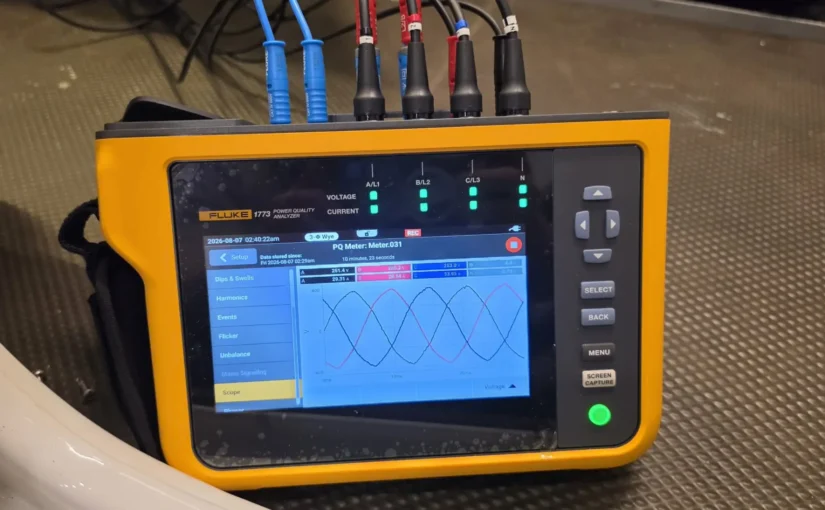
TESS Electrical Sales & Services uses professional Fluke Power Quality Analyzer equipment, including the Fluke 1773, to measure harmonic distortion, monitor system behavior, and verify corrective work. On a recent yacht project, TESS documented a 66.3% reduction in representative voltage harmonic distortion after configuring a Meanwave PQi active harmonic filter.
What Is Harmonic Distortion in a Marine Electrical System?
Harmonic distortion occurs when the electrical waveform deviates from a clean sinusoidal shape. Total Harmonic Distortion (THD) helps quantify that distortion, while individual harmonic measurements can reveal conditions that remain hidden during a basic electrical inspection.
On modern yachts, several electronic loads can operate simultaneously and interact with the same network. A marine power quality analysis therefore looks at voltage, current, harmonics, waveform behavior, and how those conditions change over time.
This helps Captains, Chief Engineers, ETOs, yacht managers, shipyards, and electrical contractors determine whether an electrical problem is related to harmonics or whether another cause should be investigated. TESS also provides dedicated harmonic analysis and reporting for vessels that require a deeper evaluation of electrical distortion and power quality.
What Causes Harmonic Distortion on Yachts?
Harmonic distortion is commonly introduced by nonlinear electrical loads. These loads can alter the waveform even when the equipment itself appears to be operating normally, making the problem difficult to recognize from a single voltage reading. Common onboard sources include:
- Variable frequency drives (VFDs) used to control motors and pumps;
- Battery chargers and rectifiers that convert and condition electrical power;
- Inverters and shore power converters connected to the vessel’s power network;
- Air-conditioning systems and other equipment using power electronics;
- Other nonlinear electronic loads operating simultaneously onboard.
The vessel’s electrical environment also changes constantly as equipment starts and stops and generator configurations change. For that reason, a one-time measurement may miss the conditions that trigger the problem. Power quality trending provides a clearer view by showing how voltage, current, harmonics, and waveform behavior respond as real vessel loads change over time.
What Problems Can Poor Power Quality Cause Onboard?
A power quality survey may be appropriate when a vessel experiences recurring electrical problems that standard troubleshooting has not fully explained. Some of the most relevant warning signs include:
- Unexplained electronic equipment failures;
- Nuisance breaker trips;
- Transformer or conductor heating;
- Generator instability;
- Problems associated with VFDs;
- Abnormal waveform conditions;
- Recurring charger, inverter, or power-supply failures.
These symptoms do not prove that harmonics are responsible. Harmonic analysis helps determine whether power quality is actually contributing to the problem. TESS can connect a Power Quality Analyzer while major loads are operating and evaluate voltage, current, THD, individual harmonic orders, and system behavior. When the investigation also requires a broader evaluation of how electrical demand is distributed across the vessel, TESS can perform an electrical load analysis to assess the power distribution system under operating conditions.
How TESS Measures Marine Power Quality With the Fluke 1773
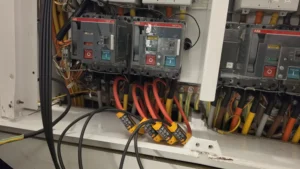
The Fluke 1773 Power Quality Analyzer allows TESS to evaluate information that a standard multimeter cannot provide. During an onboard power quality analysis, the team can monitor:
- Voltage and current across the electrical network;
- Total Harmonic Distortion (THD);
- Individual harmonic orders;
- Waveform behavior;
- Changes that occur as major vessel loads are operated.
Trending is particularly useful because many electrical issues appear only under certain operating conditions. A problem may emerge when a specific system starts, when vessel demand increases, or when the generator configuration changes. The same equipment can also be used after corrective work to compare before-and-after performance.
Case Study: Reducing Voltage THD From 6.32% to 2.13%
An active harmonic filter is power-quality equipment designed to reduce harmonic distortion in an electrical network. In this application, the Meanwave PQi’s performance was verified through before-and-after measurements using the Fluke 1773.
On a recent project, TESS installed a Meanwave PQi Active A3 harmonic filter to improve the vessel’s harmonic performance. After installation, the team returned with the Fluke 1773 to establish a baseline, configure the PQi for the vessel’s actual electrical environment, and measure the result under changing operating conditions.
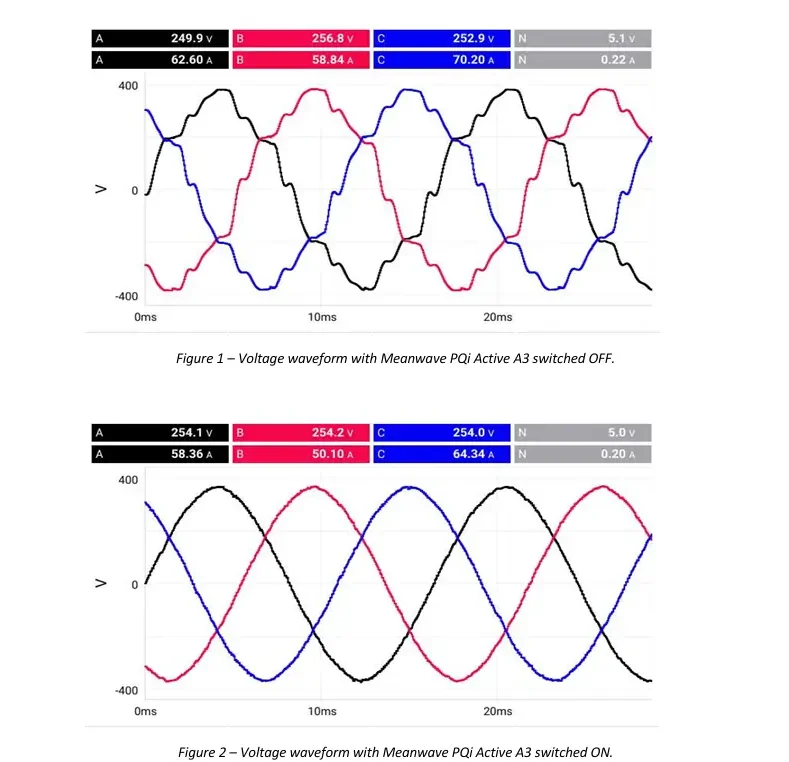
With the active harmonic filter switched OFF, representative average voltage THD measured 6.32%. After the Meanwave PQi was configured and operating, the representative average dropped to 2.13%, representing a 66.3% reduction in representative voltage harmonic distortion.
| Measurement | Representative Average Voltage THD |
| Meanwave PQi OFF | 6.32% |
| Meanwave PQi configured and operating | 2.13% |
| Reduction | 66.3% |
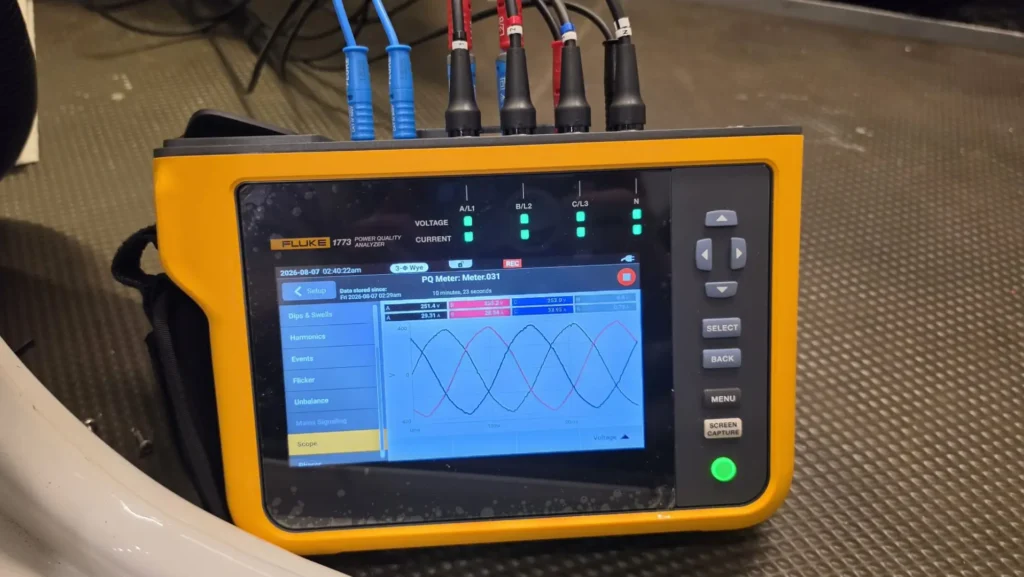
The improvement was also visible in the waveform. With the PQi switched off, the three-phase voltage waveform showed significant deformation. With the configured filter operating, the waveform became substantially smoother and much closer to a clean sinusoidal supply. This before-and-after measurement provides direct evidence of the system’s improved harmonic performance.
Why Active Harmonic Filter Configuration and Testing Matter
An active harmonic filter cannot simply be installed and assumed to be effective. It needs to be correctly sized, installed, configured, and tested within the vessel’s actual electrical environment. On this project, the yacht operated on one or two generators depending on load, and the crane was run several times during the final measurement so TESS could evaluate the PQi under both steady and changing conditions.
The final three-phase average voltage THD was 2.13%, while maximum measured voltage THD remained at or below 4.05% during the final evaluation. The dominant 5th and 7th harmonics were also brought under effective control. This is why verification matters: the goal is not to say an installation should work, but to measure the network again and prove what changed.
TESS is a Meanwave dealer in the United States and has supplied, installed, configured, and commissioned Meanwave PQi Active Harmonic Filters on multiple yacht projects. This work is part of TESS’s broader marine electrical services, which include electrical diagnostics, engineering, system integration, power management, installations, and onboard electrical upgrades.
When Should a Yacht Have a Power Quality Survey?
A vessel does not need a confirmed harmonic problem before requesting a power quality survey. In many cases, the purpose of the survey is to determine whether harmonics are involved at all. It can be useful when the engineering team is dealing with recurring failures, generator instability, abnormal waveforms, suspected VFD-related problems, or other electrical behavior that has not been fully explained.
Rather than starting with a predetermined solution, TESS can connect the Fluke Power Quality Analyzer and observe the network as relevant loads are operated. The resulting Power Quality & Harmonics Report documents the findings and recommendations, helping the vessel decide whether harmonic mitigation is required or whether the investigation should move in another direction.
What Happens During a TESS Power Quality & Harmonics Survey?
TESS follows a measured process designed to move from diagnosis to verified corrective action:
- Measure: Monitor the vessel’s electrical network under relevant operating conditions;
- Analyze: Review voltage, current, harmonics, waveform behavior, and operating trends;
- Recommend: Document the findings and define the appropriate next step;
- Install: Supply and install a Meanwave PQi Active Harmonic Filter when filtration is required;
- Configure: Adjust the system for the vessel’s actual electrical environment;
- Verify: Reconnect the Fluke PQA and measure the final performance.
This process gives the engineering team a clear sequence from diagnosis to verified corrective action. If active harmonic filtration is appropriate, TESS can supply, install, configure, and commission the Meanwave PQi Active Harmonic Filter range for marine applications, then reconnect the Fluke PQA to confirm the final performance with measured data.
Power quality and harmonics testing can also be part of larger yacht electrical refit projects, particularly when vessels are upgrading power distribution, converters, automation, or other major onboard electrical systems.
Frequently Asked Questions
Can a multimeter detect harmonic distortion on a yacht?
A multimeter can confirm voltage, but it does not provide the detailed waveform and harmonic data available from a Power Quality Analyzer. A yacht can therefore show apparently normal voltage while harmonic distortion is still present in the electrical network.
What equipment can cause harmonic distortion onboard?
Common sources include VFDs, battery chargers, rectifiers, inverters, shore power converters, air-conditioning systems, and other nonlinear electronic loads connected to the vessel’s electrical network.
Why should an active harmonic filter be tested after installation?
Installation alone does not prove how the filter performs under actual vessel conditions. Testing after configuration allows the system to be evaluated while loads and generator conditions change and provides measurable evidence of the filter’s effect on harmonic distortion.
What did the Meanwave PQi achieve in this TESS installation?
Representative average voltage THD decreased from 6.32% with the filter off to 2.13% after configuration, a 66.3% reduction in representative voltage harmonic distortion.
Can TESS perform a power quality survey before installing a filter?
Yes. TESS can use its Fluke Power Quality Analyzer to investigate voltage, current, harmonic distortion, individual harmonic orders, and system behavior before recommending corrective action.
Measure the Problem Before Choosing the Solution
Power quality problems are not always visible in a standard voltage reading, and recurring electrical issues do not automatically mean harmonics are the cause. A professional survey provides the data needed to identify what is happening in the network before choosing a corrective strategy.
On this project, TESS documented representative average voltage THD decreasing from 6.32% to 2.13% after configuration of the Meanwave PQi system, a 66.3% reduction.
Contact TESS Electrical Sales & Services to schedule an onboard Power Quality & Harmonics Survey. TESS can measure the system, identify the issue, and recommend or implement the appropriate solution when harmonic filtration is required.